It’s The Act, Not The Narrative You’ve Projected
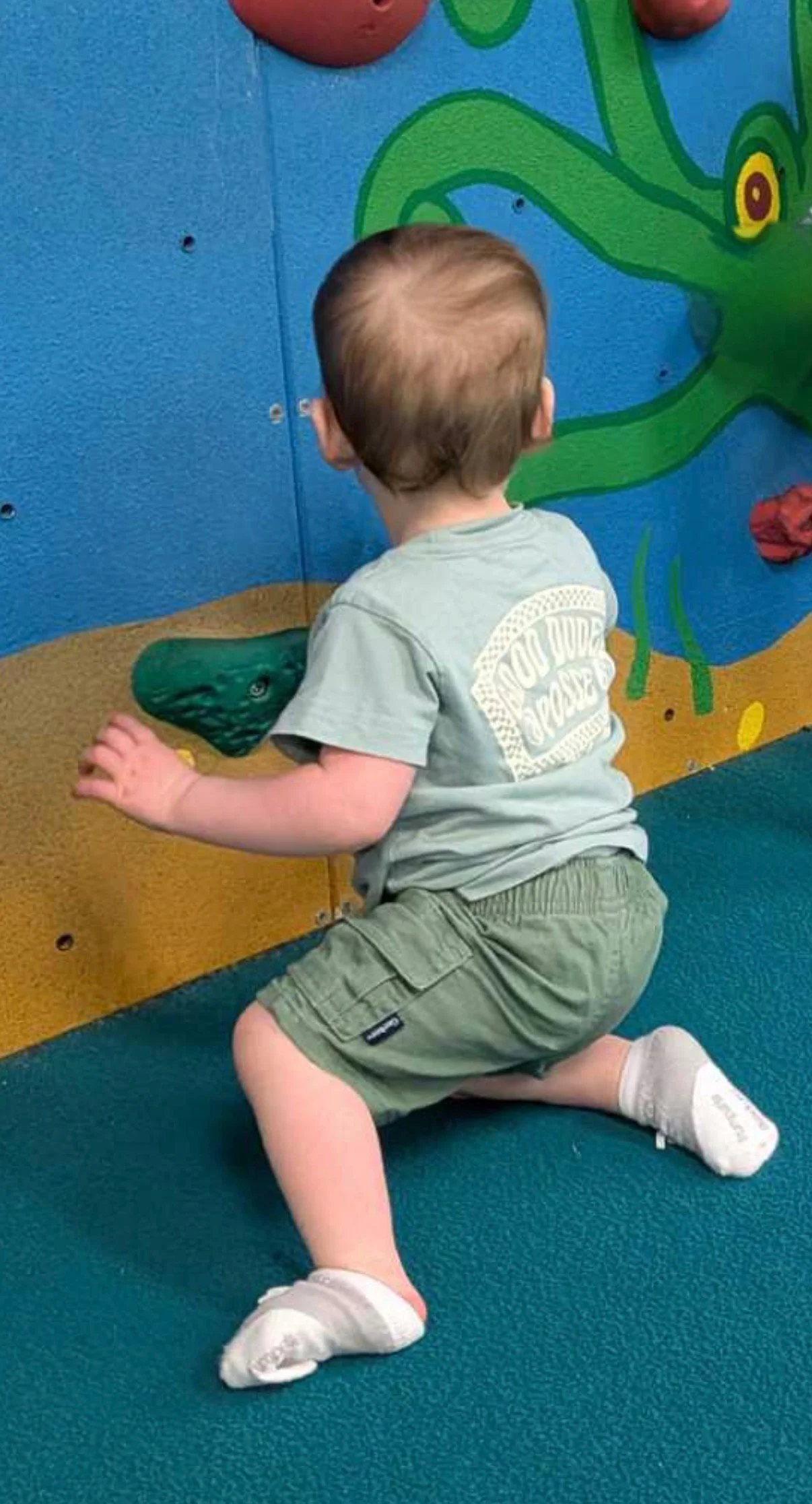
A baby reaches toward a climbing wall, back to camera, representing curiosity and the foundation parents build for donor-conceived children.
Being a donor is a lot more nuanced than some may realize.
On April 27, 2026 it was International Donor Conception Awareness Day. As a Single Mother By Choice (SMBC) who had my donor-conceived child via sperm donor, I was ecstatic to have the opportunity to profess my infinite gratitude to my sperm donor. My son, my son specifically, wouldn’t be here if it weren’t for my chosen sperm donor, and for that, I will be forever indebted to his contribution.
So as a licensed marriage and family who specializes in perinatal mental health, I carefully crafted a post to share my appreciation and spread awareness to donor conception and the overgeneralizing beliefs towards sperm donor motivation.
I’m a member of a support group for Single Moms By Choice and felt that it was the obvious choice to share my post with a community that is donor dependent in multiple ways.
It came as a devastating shock when my post had a comment from another member saying (and I’m paraphrasing) that sperm donors most likely just needed the beer money and it’s not only problematic, but it’s irresponsible parenting to be romanticizing the idea of the donor being this wonderful and selfless hero to children. She went on to say that when the child goes on to eventually meet their donor, they will find out they only exist because he needed the beer money.
I kindly replied, chest tightened, hands shaking and all, “I hear you. For me personally, regardless of the reason, they donated and it resulted in a very wished for child. It’s the act of it for me, not the reason behind the act. I also appreciate my donor’s personal essay for his decision to donate on his profile. I choose to belief it was written with authenticity. That’s been my experience. I can’t speak for others.”
At first, no one liked or hearted my reply, but someone liked the other person’s response and piggybacked on it to say how most sperm banks advertise on college campuses and she doubts these 20 somethings are donating with thoughtful generosity, followed by a laughing emoji.
That comment was liked as well and I thought to myself, “Here we go with the mean girl bully gang up. This is why I never post. This is why it’s unsafe to be vulnerable. Would they be saying this about an egg donor? The audacity to shame me and judge me on a post expressing gratitude to my son’s donor after my excruciatingly challenging infertility and pregnancy loss journey ON International Donor Conception Awareness Day of all days?!”
Then my anger started to flood in. My loved ones told me to let it go, not let it bother me, don’t engage, but every cell in my body raged with the injustice and inappropriateness of these responses, in a support group, for a population that’s donor-dependent.
I chose to go straight to admin of the group and I will say that admin handled the situation beautifully to where I felt heard, validated, and protected. However, my work here wasn’t done, it was just getting fired up.
I sat uncomfortably with these women’s responses to my post for a while. Yes, everyone is entitled to their own opinion, but read the room ladies!
Let’s Talk About What Actually Happened Here
One, that overgeneralization is inaccurate, disrespectful, and harmful. Would you tell people in a cancer support group that their oncologist just does it to own a BMW? Would you tell the author who thanks their teacher for inspiring them to write that they probably only cared about getting summers off? Would you tell someone the EMT who saved their life was just in it for the adrenaline rush?
Two, no judgement for anyone receiving money for a donation (plasma donors save lives AND may be doing it because they need money). You don’t know what people need money for and it’s a win/win.
Three, expressing gratitude isn’t the same as romanticizing, idolizing, or pedestal placing. It’s an important value being modeled for your child.
Four, um, your kid wouldn’t be here if it weren’t for that donor, so where is this anger towards them coming from?
If you really wanted to be cynical about the origin stories behind children’s births, you could say “One day you’ll find out you only exist because your parents were horny one night, or your mom had a one-night-stand with a hot bartender, or it was spring break and everyone was wasted.
Can you see how much that dismisses and invalidates someone’s existence? After seeing how much goes into getting pregnant, staying pregnant, and having that pregnancy result in a live birth, it is an absolute MIRACLE that we are all here.
WHAT THE RESEARCH ACTUALLY SAYS
Research identifies four documented motivations for sperm donation: altruism, financial compensation, procreation, and confirming one’s own fertility. Studies consistently show these motivations coexist, not compete.
A review of multiple studies found that between 15% and 67% of sperm donors cite helping others as a motivation, while 62%–74% also report financial compensation as a factor. Most donors describe a combination of reasons, not a single driving force.
Source: Peer-reviewed literature reviewed in Daniels (2005); systematic review published in Human Reproduction.
My CTA (Call to Action)
It was then that I realized this negative interaction online is actually my calling for some valuable psycho education for anyone looking into donor conception, has a donor-conceived child/children, and providers who work with this population.
The fact of the matter according to research shows that Donor Conceived Parents (DCP) views are genuinely a spectrum, not a consensus.
Survey responses from donor-conceived adults include words like overwhelmed, intrigued, weary, angry, confused, frustrated, resentful, and all of those feelings are valid.
There is no unified DCP position on donor motivation or parental gratitude.
And as for the claim that it’s “irresponsible” to tell your child anything positive…
(Please hold, I’m putting my therapist cardigan on for this one)
The bigger issue my research mentions is not parental gratitude for the donor, it’s the secrecy and late disclosure to the child. In addition to this, modeling and teaching the values of gratitude, acceptance, and developmental age appropriate transparency is extremely important.
WHAT THE RESEARCH ACTUALLY SAYS
A 2024 systematic review of over 50 studies with more than 4,500 participants (King’s College London) found that donor-conceived people have equal or better psychological outcomes than those not conceived via donation, scoring higher on wellbeing, self-esteem, and relationship warmth.
The single strongest predictor of positive outcomes? Early, open disclosure. Not parental cynicism.
Not withholding gratitude.
Donor-conceived people who learned about their origins at a young age showed more positive attitudes toward their conception and warmer relationships with their parents.
Source: British Journal of Obstetrics and Gynaecology, 2024; longitudinal research from the UK Study of Assisted Reproduction Families.
For my son, I will share some fun and interesting facts about his donor. I will base it off of the information provided by Xytex that aligns with our family values. I’m not going to tell him his donor is anything other than details I was given. I don’t know his donor. I just know that he provided what was missing for my son to be in my arms.
Now for the Psycho Education Part
I decided to go straight to the source and contact the sperm bank I used for my IVF, which was Xytex in Georgia.
Xytex was the best choice for me, particularly because they include adult pictures of the donors in addition to the baby and child photos and they are incredibly thorough regarding donor profiles, which you’ll see in their process explained by their team.
Their customer service was empathetic and informed, especially when I found out I was CMV negative (see more about this in my IVF post) and the donor I initially reserved to purchase was CMV positive and I needed to make a different selection. They sent me a hand-written card to congratulate me and welcome my son Mayer into the world after my birth report was verified (which I still have on my fridge).
When I emailed them to ask if they’d be open to participating in a post in writing to humanize the donor experience, the President of the company, Mary Anna Hamilton herself, promptly responded with an open and curious outlook.
My Questions Answered By Xytex
Can you walk me through the full donor screening and vetting process at Xytex from application to acceptance?
Xytex is registered with the United States Food and Drug Administration (FDA) and complies with all applicable regulations. The donor qualification process includes multiple stages designed to evaluate the eligibility, health, and suitability of donor candidates. FDA regulations require screening through medical history review, infectious disease testing, and physical examination for signs of relevant communicable diseases.
Xytex also conducts additional evaluations including:
• Detailed personal and family medical history reviews
• Psychosocial assessments
• Background checks
• Educational verification
• Genetic carrier screening
• Donor profile development
Additional information regarding the donor process and screening requirements can be found on the Xytex website and through FDA guidance documents.
What percentage of applicants are accepted into your donor program?
Approximately 1% of donor applicants ultimately become active donors within the Xytex donor program.
WHAT THE RESEARCH ACTUALLY SAYS
1 out of every 100 applicants becomes an active Xytex donor.
This is not a casual transaction. This is a selective, multi-stage process with a 99% rejection rate.
What psychological and personality evaluations are part of the process?
Donor candidates complete a personality profile evaluation and participate in a psychosocial assessment and counseling session conducted by an independent third-party professional. These evaluations are intended to assess emotional readiness, communication abilities, and overall suitability for participation in the donor program.
What genetic and medical screenings are required?
Donors undergo comprehensive medical screening, including personal and family medical history evaluations related to hereditary and genetic conditions. All donors also complete genetic carrier testing. As genetic testing technology has evolved, the scope of testing panels has expanded accordingly. Currently, donors undergo carrier screening utilizing Natera’s 613-Gene Horizon panel.
Each donor profile includes a detailed summary of the genes evaluated during testing, and the donor’s genetic testing reports are available for download directly from the Genetic Testing section of the donor’s online profile.
Do donors complete a personal essay or interview about their motivations? How is that evaluated?
Yes. Donors independently author a personal essay as part of their profile process. Xytex reviews the essays and only edits content that could potentially identify the donor personally. The essays are intended to provide prospective clients with additional insight into the donor’s personality, background, and motivations.
How does Xytex’s internal vetting exceed FDA requirements?
FDA regulations primarily focus on reducing communicable disease risks associated with tissue donation. Xytex’s internal screening process extends significantly beyond these regulatory requirements. Additional evaluations performed by Xytex include:
• Detailed personal and family medical history review
• Psychosocial assessment and counseling
• Background checks
• Third-party educational verification
• Expanded genetic carrier testing
• Development of extensive donor profiles, including photos and personal information for client review
These measures are designed to provide intended parents with additional information and support during the donor selection process.
Do you accept egg donors as well, and is their vetting process comparable?
Xytex does not accept or manage egg donors. The organization focuses exclusively on donor sperm services and related reproductive tissue services.
What do you wish the general public understood about your donors that they currently don’t?
Xytex Corporation has operated as a sperm bank since 1975 and, to our knowledge, was among the first large-scale commercial sperm banks in the United States. As a 100% employee-owned organization, Xytex remains committed to quality, compassion, innovation, and supporting individuals and families throughout their family-building journeys.
We believe many people do not realize the level of screening, oversight, and ongoing evaluation involved in the donor process. Only approximately 1% of applicants ultimately become active donors. Donors undergo extensive medical, genetic, psychosocial, and infectious disease screening prior to acceptance into the program.
Xytex also believes transparency is important for donor-conceived families. We no longer onboard anonymous donors and have transitioned to ID-disclosed donor options.
Additionally, Xytex provides both adult and childhood photos for all donors as part of the donor profile experience to help intended parents make informed and personal decisions during the donor selection process.
With six donor recruitment sites across the United States, Xytex is able to support a broad and diverse donor pool representing a wide range of backgrounds, ethnicities, education, interests, and personal characteristics.
How do you support donor-conceived families in talking to their children about their origins?
Xytex encourages openness and transparency regarding donor conception. The organization has transitioned exclusively to ID-disclosed donors and no longer onboards anonymous donor options. Donor profiles remain accessible to clients and donor-conceived individuals, and profiles are updated whenever new information becomes available. Xytex also provides educational resources and support materials through its website to help families navigate conversations surrounding donor conception and family building.
In addition, Xytex collaborates with several organizations and communities that support donor-conceived individuals, intended parents, and fertility education. We believe continued dialogue, education, and access to resources are important in helping families navigate donor conception in an informed and compassionate manner.
My Final Thought
So as you can see, being a donor is a lot more nuanced than being some random college kid who wants money to do a keg stand. It requires a lot of time, testing and thought. They are literally giving a piece of themselves and their family history to you. Quite frankly, this type of service is worthy of monetary compensation for both the donor and the donor banks because of all of the hard work that goes into this process.
I whole-heartedly back my post for International Donor Conception Awareness Day and with my intentional approach to educating my donor-conceived child, I’m confident my son will too. Thank you Xytex for your participation with this post and for connecting me with my son’s donor.
Resources
Postpartum Support International (PSI) Provider Directory postpartum.net
Xytex Sperm Bank xytex.com
We Are Donor Conceived Survey Results wearedonorconceived.com
King's College London Systematic Review: Psychological Experiences of Donor-Conceived People britishjournalofobstetrics.org
UK Longitudinal Study of Assisted Reproduction Families kclondon.ac.uk
If you are located in Florida, California, or Tennessee and are looking for individual support, I would love to work with you. Learn more about therapy services at bethsiller.com.
Not in one of those states? Beth offers virtual workshops and professional trainings available nationwide. Find out more at bethsiller.com.
This post is for informational purposes only and does not constitute therapy or medical advice. Beth P. Siller, LMFT is a licensed therapist, not a physician. Please consult a qualified medical or mental health professional for personalized support.
If you are struggling with perinatal mental health concerns, support is available. Contact the Postpartum Support International helpline at 1-800-944-4773.
