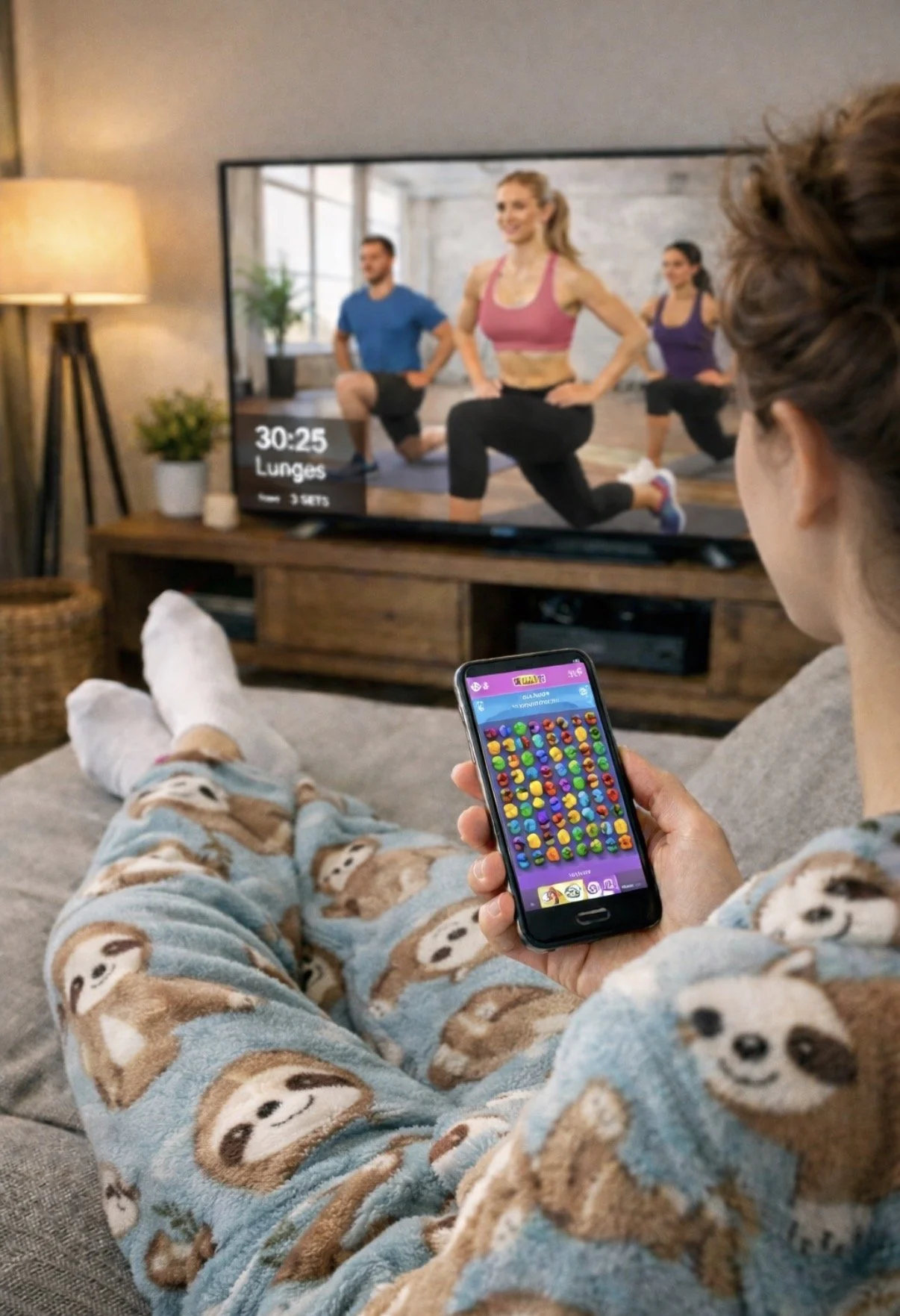
Does Watching Videos of Cleaning, Cooking, and Exercising Count as Being Productive?
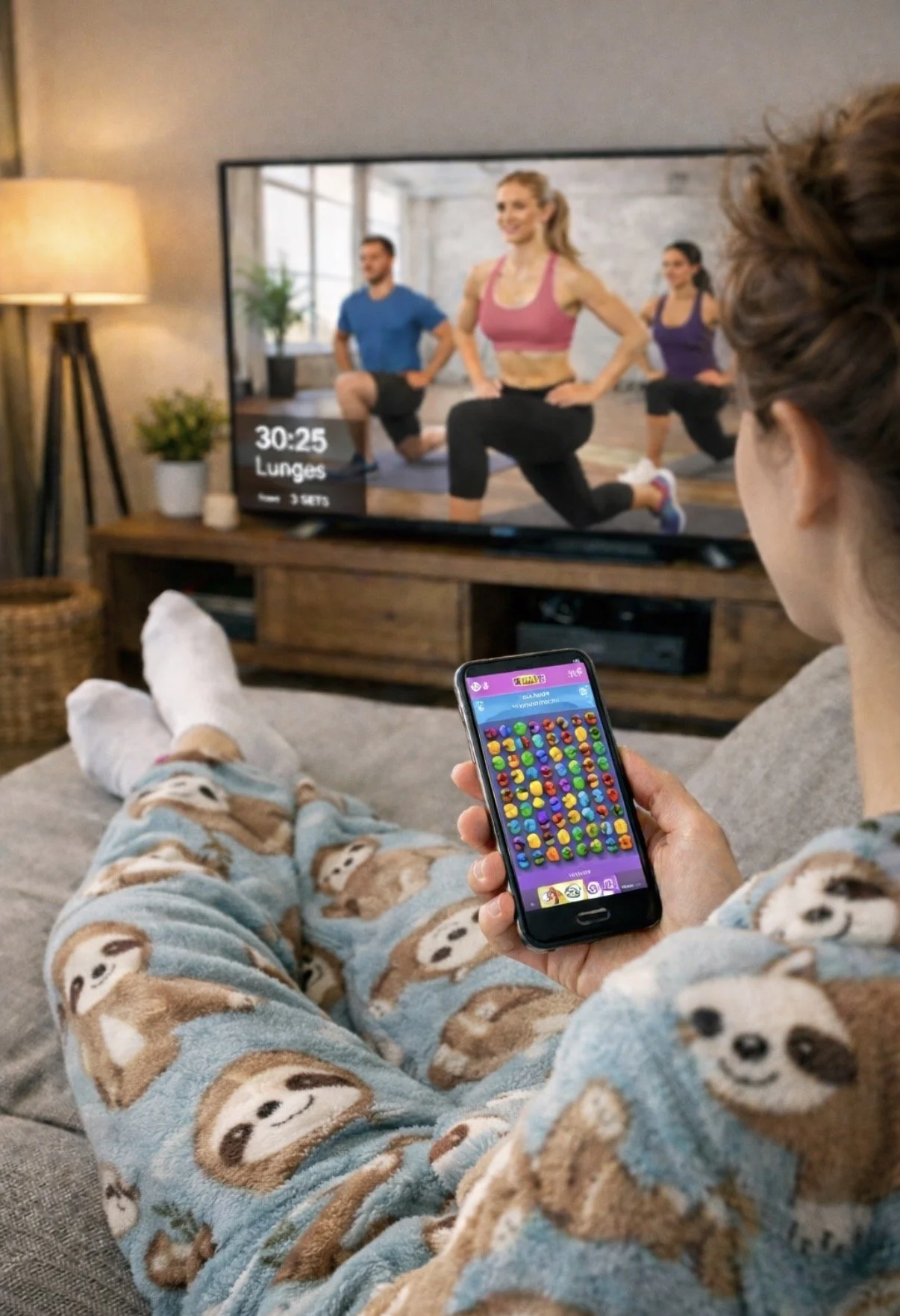
Woman overwhelmed and sitting on couch scrolling phonewith postpartum productivity paralysis
A Story That Could Be Any Mother's, this blog is a work of fiction. Names, characters, businesses, places, events, and incidents are either the product of the author's imagination or used in a fictitious manner. Any resemblance to actual persons, living or dead, or actual events is purely coincidental.
When It's Not the Thought That Counts
Too exhausted to hydrate, take meds, take supplements, you realize it's nearing 5pm and you haven't left the house at all let alone brushed your teeth. You feel like you've somehow beat the system by skipping flossing or taking your meds but not your vitamins. When was the last time you've showered? Getting your body wet and then cold? No thanks. Washing your hair and dreading seeing the hairball you've created from all the shedding and then having to throw it into a topknot and see all the weird hair growing back that you initially lost postpartum? Heaven forbid. You imagine yourself blowing your hair out like you did in the “Days of Yore” (Friends reference) which exhausts you even further.
You find yourself relating to Adam Sandler in Big Daddy when he covers everything from urine to spilled milk with newspaper just to avoid cleaning it, except no one gets newspapers anymore so now what? This entire 2 hrs, you've been watching reruns on TV while doom scrolling and bed rotting. Suddenly, you remember, "I haven't checked my mail in weeks. It's probably all bills I can't afford to pay. Is my baby still breathing? I'll stare and stare until I see movement, okay phew, he moved. Remember that time in college when that guy you were obsessed with traumatized you for life? What about when you got wrongfully terminated for having a sinus infection and miscarriage in the same month and it was super inconvenient for them?
Ugh someone's calling and I just can't deal" sounds familiar?
Have you ever had a major project to do and instead of doing it, you've stared into the ether and got exhausted by picturing yourself doing it all step by step? For some people, that is happening throughout the day with even the most fundamental "to do" lists. I'm talking about the days when getting out of bed to go to the bathroom was your biggest success of the day. These struggles are one hundred percent valid when you are struggling with ADHD, anxiety, depression, postpartum, grief, burnout and/or infertility (just to name a few). Don't get me started on comorbitities/having a diagnoses parade...
Whatever it is that you're experiencing internally to the point of impeding your ADLs (activities of daily living) has a name. Actually, it has several, depending on which page of the DSM-5 you happen to be bookmarked in.
The frozen, zombie, doom-scrolling, hair-unwashed, mail-avoiding, baby-breathing-checking experience is remarkably consistent across diagnoses that may be difficult to understand from outside of the fishbowl.
Productivity paralysis isn't laziness or incompetence. It's not a character flaw or an accountability defect. It's not what happens because "you must want it badly enough." It's what happens when your nervous system is so overwhelmed by the gap between what needs to happen and what feels possible that it shuts the whole operation down. It's your brain and body's version of too many tabs open and the window pops up saying "website not responding".
Do you hit "cancel" wait it out? Do you hit "retry" and keep your fingers and toes crossed that you'll somehow get a jolt of energy to do what feels so far-fetched? Or do you hold the power button down to reset deeper than restarting would achieve?
The Science: What Productivity Paralysis Actually Is
Productivity paralysis is rooted in executive dysfunction which is difficulty with the brain processes that regulate planning, initiating, and completing tasks. The prefrontal cortex, which governs these functions, is highly sensitive to stress hormones like cortisol. When cortisol is chronically elevated as it is in depression, postpartum, burnout, and anxiety, the prefrontal cortex activity is suppressed, making task initiation feel neurologically and physically impossible rather than just your average difficult or stressful.
Dopamine dysregulation a.k.a. “dopamine feen” compounds this: without adequate dopamine signaling, the brain's reward circuitry cannot generate the motivational pull needed to start or sustain effort (Arnsten, 2009; Schultz, 2016).
Let's discuss about how each one presents itself because feeling similar doesn't mean it's the same. Awareness is the precursor for action followed by change so let's get into it.
ADHD
With ADHD, the paralysis can feel offensively specific. You can hyperfocus for four hours on something nobody asked you to do (yet it's somehow a preferred task for you) and then be completely unable to send a two-word text response that you remember to do at the most inconvenient times. The issue isn't motivation, it's the executive functioning skill of task initiation that's getting you down. Your brain needs a dopamine hit to start a perceived non preferred task, and the guilt or shame of the "shoulds" isn't going to cut it. Neither is "it's time-sensitive" or "people are waiting on me" or "I've already put it off for two weeks, what's a couple more days gonna hurt?"
ADHD brains run on interest, reward, urgency, challenge, and a spark of passion. Obligation is overlooked because it doesn't scream "fireworks" very much, does it? The mail you haven't checked in over three weeks? That's not avoidance in the traditional sense. That's your nervous system calculating (correctly I must add) that opening an envelope with unknown contents provides zero dopamine and potentially a lot of cortisol/stress. Your brain did the math and your brain said "Nope, not today universe, not today!"
The Science: ADHD and Task Initiation
ADHD is associated with dysregulation of dopamine and norepinephrine pathways, particularly in the prefrontal cortex and striatum. Dr. William Dodson's interest-based nervous system model describes how ADHD brains are neurologically driven by interest, challenge, urgency, and passion rather than importance or obligation. Task initiation, beginning a task without external prompting, is a core executive function that is consistently impaired in ADHD, independent of intelligence or desire. (Dodson, 2016; Barkley, 2012; Solanto et al., 2010)
Postpartum
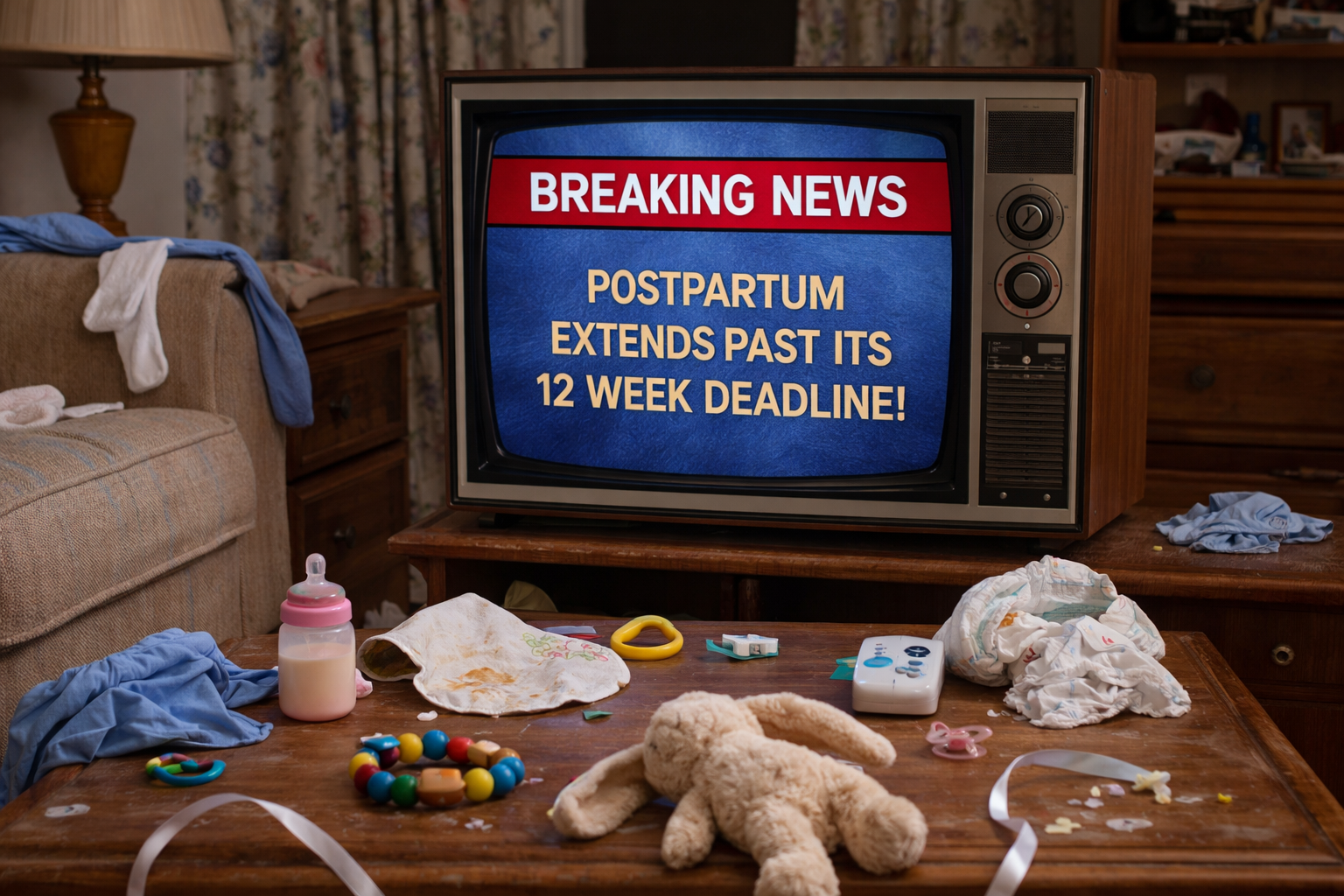
Postpartum paralysis has all the ingredients to make you a mean trick salad because it arrives at the exact moment you can't afford for it to. You know that human you just grew and brought into the world? The one you are keeping alive during one of most physically, emotionally and mentally taxing times of your life? Well, you are somehow doing what car-lifting super mommas can do on no sleep, however you can't imagine changing out of your dirty clothes or showering.
The hormonal crash after birth is nothing those pesky monthly dues (not dismissing terrible periods by any means). Estrogen and progesterone drop off a cliff, landing on a mountain all while rolling down shouting, "As you wish Buttacup!" in the days after delivery. Add in sleep deprivation which functionally impairs cognition the same way intoxication does (cue in psychological warfare tactic) and you have a brain that genuinely cannot prioritize, sequence, remember or initiate tasks the way it used to.
The baby breathing check isn't paranoia. The intrusive memories of being traumatized by your crush in college aren't random. That's a postpartum brain doing exactly what a postpartum brain does: threat-scanning on crack with memory consolidation disrupted, all while your executive function is offline with an away message quote from a Green Day song.
You're not a bad mom. You're postpartum.
The Science: Postpartum and the Brain
The postpartum period involves one of the most dramatic hormonal shifts in human experience. Estrogen and progesterone which reach peak levels during pregnancy drop precipitously within 24-48 hours of delivery, affecting serotonin regulation and mood stability. Sleep deprivation compounds this: research shows that 17-19 hours of wakefulness produces cognitive impairment equivalent to a blood alcohol level of 0.05%.
Postpartum anxiety and depression also activate the amygdala's threat-detection system, producing hypervigilance (including infant breathing checks and intrusive thoughts) as a protective neurological response, not a sign of instability. (Doing & Bhivandkar, 2021; Williamson & Kolb, 2020)
Depression
Depression is a liar. It tells you the paralysis is permanent and you've always been this way because you suck. Your brain on depression loves the comparison game where you view everyone else managing life just fine, thriving even! The fact that you haven't left the house in a couple of days is evidence that you're a pathetic loser who is destined to fail.
It is very convincing and it is completely full of shit.
What depression actually does is reduce the motivational circuitry in your brain to a mere flicker. The things that used to feel worth doing don't feel worth doing because what's the point?
Movement feels like those nightmares where you try to use your legs to runaway from monsters in a dream but it feels like you’re wading through rushing water that’s against the current. Starting something feels like lifting something very heavy just to feel regret afterwards instead of any type of reward.
The reruns are on because they're familiar, predictable and it requires nothing from you. The doom scrolling is on because it provides micro-hits of stimulation that your depleted brain is desperately trying to collect in order to feel anything other than numb. This isn't weakness, it's neurochemistry.
The Science: Depression and Motivational Circuitry
Depression is associated with reduced activity in the brain's reward circuitry, particularly the nucleus accumbens and dopaminergic pathways. Anhedonia, the reduced capacity to experience pleasure or anticipate reward is a hallmark symptom that directly impairs motivation and task initiation.
Behavioral Activation Therapy (BAT) is one of the most evidence-based treatments for depression precisely because it works with this neurological reality: small, values-aligned actions can restore dopaminergic activity even before mood shifts. The behavior moves first; the feeling follows. (Jacobson et al., 2001; Pizzagalli, 2014)
Anxiety
Anxiety paralysis caused by anticipatory anxiety is the one that looks like laziness or being selfish from the untrained eye. This can feel infuriating to experience because the anxious person isn't doing nothing while resting on the couch, they're doing everything, but internally so it appears invisible to everyone else. They're pre-experiencing every possible outcome of opening the mail. They'rerehearsing the phone call they can't make. They're managing and even feeling the imagined consequences of the thing they haven't done yet while also managing the imagined consequences of the thing after that and after that and so on.
The reason you can't start is because starting would make it real, and real means it can go wrong, and wrong is something your nervous system has decided it cannot survive right now. Avoidance is anxiety's best friend and it shows up to protect it every single time, however, it makes everything worse in the long run. Your nervous system doesn't care about the long run. It cares about right now.
The Science: Anxiety and the Avoidance Cycle
Anxiety activates the amygdala's threat-detection system, which signals the body to prepare for danger even when the threat is a pile of unopened mail. Avoidance provides immediate relief as the cortisol drops and the nervous system settles which powerfully reinforces the avoidance behavior through negative reinforcement.
Over time, the avoidance generalizes, more and more tasks feel threatening, the window of tolerable action narrows, and the paralysis deepens. Exposure-based approaches work by gradually disrupting this cycle, teaching the nervous system that the feared outcome is survivable. (Craske et al., 2008; LeDoux, 2015)
Burnout
Burnout paralysis is what happens after you've been doing everything your inter critic is telling you should’ve already done yesterday, if you were a good person. Your guilt, shame and insecurities are encouraging you to push through and keep on truckin' so you'll be worthy and you do it for so long that your system finally send you the invoice plus interest. It's not quite sadness or anxiety, it's depletion. You're driving with an empty tank, pouring from a cup without coffee, the mall is open but nobody's shopping, you get the idea.
The things you used to care about feel like a waste of time. The things you have to do feel pointless. You've been overextending yourself for so long that relating to Ennui from Inside out 2 feels like the norm.
Burnout doesn't respond to motivation because motivation requires resources and those resources gone fishing. Telling someone in burnout to push through is like telling someone with laryngitis to go give a Ted Talk. It's time to rest and recover whether you like it or not.
The Science: Burnout and Nervous System Depletion
Burnout is characterized by dysregulation of the hypothalamic-pituitary-adrenal (HPA) axis which is the body's central stress response system. Chronic overextension leads to cortisol dysregulation, which can present as both elevated cortisol (hyperarousal, difficulty sleeping) and depleted cortisol (exhaustion, emotional flatness, motivational collapse). Research distinguishes burnout from depression by its occupational and contextual origins, though the neurological overlap is significant. Recovery requires genuine rest and nervous system restoration, not reframing or pushing through. (Maslach & Leiter, 2016; Bianchi et al., 2015)
So what could help you ask?
For starters, it's NOT going to be shaming yourself. Sure, there are productivity hacks, The 5am Club and bullet journals you can buy on Amazon. There are even motivational quotes on cute pillows you can find at Anthropology. Those are all fine and dandy, but they'll do squat for people whose nervous systems aren't regulated.
You may not be regulated right now, and that's okay.
What actually helps is working with your nervous system instead of against it. Which can look different for everyone. Body doubling and walk and talk therapy can be an effective option which could lead to progress and relief. Not as productivity tools, but as clinical interventions that meet your brain where it actually is realistically.
Experiencing body doubling through a clinical lens and walk and talk therapy (not to be mistaken with doing dishes silently on FaceTime while your sister folds her laundry or hiking with your bestie) can be beneficial and both are available virtually.
Body doubling works because your nervous system responds to the presence of another regulated person in a way it can't respond to a to-do list. Walk and talk works because movement unlocks what stillness can keep stuck. Even stressing the thought or idea of having to stop everything for 53 minutes, sit across from someone virtually or in person and having bouts of uninterrupted eye contact could be what's keeping you from receiving therapy. There are other ways that work because of the work being different from what you may be used to.
The Science: Body Doubling and Walk and Talk
Body doubling leverages the neurological impact of social presence: research on ADHD and executive dysfunction suggests that working alongside another regulated person activates social accountability and co-regulation, lowering the activation threshold for task initiation. Walk and talk therapy adds bilateral movement (left-right stepping), which activates both brain hemispheres similarly to EMDR and supports emotional processing. Exposure to outdoor environments reduces cortisol and activates the parasympathetic nervous system. Sustained eye contact through a screen can be activating for trauma-affected and neurodivergent clients so by removing that demand, it can make therapeutic engagement more accessible.
(Nadeau, 2002; Revell & McLeod, 2016; Bratman et al., 2015)
Curious about body doubling or walk and talk sessions? Learn more here.
If any of this felt like you must be on The Truman Show because I see you, that was on purpose. You are not defective. You're not lazy or ungrateful. You're a nervous system doing the best it can under conditions and unrealistic expectations that were never designed to be sustainable.
Support doesn't have feel like a non preferred task.
If you are located in Florida, California, or Tennessee and are looking for individual support, I would love to work with you. Learn more about therapy services at bethsiller.com.
Not in one of those states? Beth offers virtual workshops and professional trainings available nationwide. Find out more at bethsiller.com.
This post is for informational purposes only and does not constitute therapy or medical advice. Beth P. Siller, LMFT is a licensed therapist, not a physician. Please consult a qualified medical or mental health professional for personalized support.