Newsflash: Postpartum Goes Way Beyond Your Fourth Trimester
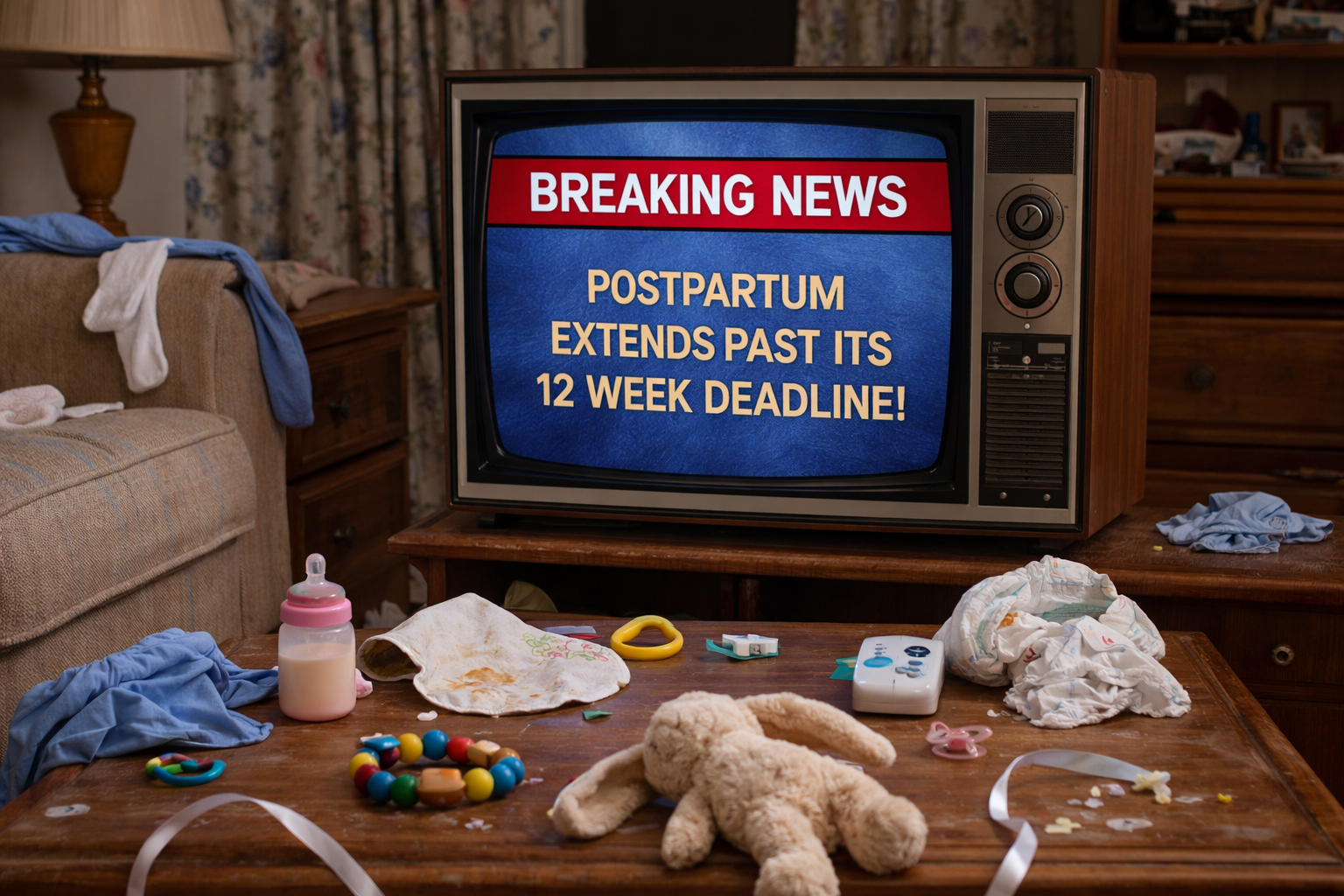
Postpartum lasts longer than the 4th trimester.
A Story That Could Be Any Mother's This blog is a work of fiction. Names, characters, businesses, places, events, and incidents are either the product of the author's imagination or used in a fictitious manner. Any resemblance to actual persons, living or dead, or actual events is purely coincidental.
And nobody warned you
Most of us have never even heard of the fourth trimester. You may have a vague understanding that pregnancy is three trimesters and that postpartum begins after the baby is born. You may also assume that postpartum only applies to women who have given birth physically. It does not. But we will get to that soon enough, don't you worry. Let’s paint a picture of this scenario, shall we?
You are in your second trimester when you first bring up your postpartum concerns with your doctor. As you negotiate how soon you can return to work, your doctor says “you’ll need to be out for maternity leave three to four months minimum.” You were aiming for two months maximum! The women on “Selling Sunset” were doing yoga and full splits in their Lululemon spandex six weeks after giving birth! This needs to be the reality, it’s called “Reality TV” for a reason dammit! You are self-employed. Maternity leave is unpaid. The cushion you had hoped to save up for does not exist. Your savings have been absorbed by the costs that brought your baby into the world and the world does not care. The negotiation feels surreal and impossible. You have not yet given birth and you are already calculating how quickly you can stop recovering. This is the unrealistic expectation the majority of us face.
What Nobody Told You About the Recovery
You had read about vaginal birth recovery. Ice packs and a peri bottle and the kinds of physical unmentionables that do not make it into the birth announcements (even though your morbid sense of humor is saying otherwise). There are resources that say C-section recovery takes about six to eight weeks, yet you now know that was complete gobbledygook!
What you had not read about was what happens when a body locks up from medical trauma. When the elimination process blocks entirely (Hello, straight catheter, have we met?) When nerve pain radiates through the ribs, back, spine, and chest in ways that no specialist can figure out, yet it feels like you’re wearing a searing hot corset with metal spikes that gets pulled tighter and tighter, especially when laying still. When the swelling starts at the feet and works upward to where everything hurts to the touch and there’s not Epsom salt in the universe that can make a difference. Is it even muscular or skeletal, ‘beats them? But pain has never actually killed anyone, right? Ah, the bedside manner of a male provider, can I get an “Amen?” Let the referral games begin!
What nobody told you was that the beginning of your postpartum experience would involve days and nights of severe pain, multiple ER visits, numerous specialist appointments with high co-pays, and moments where you could not care for yourself or your baby. You were feeling completely helpless and scared throughout it all. The clock to return from maternity leave has not skipped a tic or a tock.
"How am I supposed to help others when it physically hurts to exist right now? Is this just going to be my life now?"
Maybe you know someone navigating chronic pain and illness. You are now understanding their suffering from a completely different perspective. What you once understood intellectually has now become what it actually feels like to be in a body that is suffering and have the support around you unable to give you what you need because nothing seems to be working. This kind of empathy can only come from living inside an experience and not by only having the awareness that it exists.
After the Twelve Weeks
After the first twelve weeks following your baby's birth, you are still just as sleep-deprived, sore, and cognitively depleted as you were leaving the hospital, or wherever your baby was born. You have support from your family and yet your health is so compromised that no amount of help feels like enough. Maybe you even work from home, so how hard could it be, right? RIGHT?!
"It was so incredibly hard that there were days I did not think I could physically survive such extreme stress and pain. Even though I continued to survive each day, my next thought was always: how in the hell am I supposed to do this all again tomorrow?"
You survive. Every day. And then you see a post on social media that said:
"Postpartum ends when breastfeeding ends."
I'll give you all a minute to collect yourselves.
Deep breath. Sigh.
Not all of us breastfeed. The choice is sometimes made for us by medical necessity, by medications we cannot stop taking or need to start taking, by our bodies, our circumstances, all of which may be entirely outside our control. What about the parents who used a gestational carrier? The same-sex couple. The parents who adopted a newborn or infant. The single parent. The older mother who may also be approaching perimenopause. Is postpartum not valid for them? Do their recoveries not apply?
What the Science Actually Says
The American College of Obstetricians and Gynecologists defines the postpartum period as lasting up to twelve weeks. However, research on matrescence, the profound physical, psychological, and neurological transformation of becoming a mother, tells a much longer and more complex story. A 2023 study published in Trends in Cognitive Sciences described matrescence as a sensitive neurodevelopmental period comparable to adolescence, with brain changes that extend well beyond the immediate postpartum window and impact cognition, identity, and emotional regulation across the lifespan.
Matrescence was coined by anthropologist Dana Raphael in the 1970s and has been developed by researchers including psychologist Aurelie Athan. It describes not just the physical recovery from birth but the entire identity transformation of becoming a mother. The brain is reorganizing. The self is reorganizing. The relationships, priorities, and fundamental sense of who you are are all reorganizing. Simultaneously. On interrupted sleep.
Hormones tell a similarly extended story. Estrogen and progesterone plummet immediately after birth, directly affecting serotonin and dopamine levels and creating the conditions for mood instability, anxiety, and emotional dysregulation. While some hormones begin stabilizing around three to six months postpartum, cortisol, the stress hormone, often remains elevated far longer due to the ongoing demands of caregiving and sleep deprivation. For women who are breastfeeding, hormonal recovery can be further delayed. Some women do not feel fully like themselves again hormonally until twelve months or beyond.
Your OB mentioned that it takes approximately two years for a woman's hormones and body to fully recover after birth. That is for a typical birth. For a birth involving complications, medical trauma, surgical recovery, nerve damage, and extended physical pain, the timeline is not shorter. It is longer.
Why, then, are new parents expected to have adjusted in three months?
The Fourth Trimester Was Never the Whole Story
Not every baby will sleep on a schedule. Not every parent can sleep when the baby sleeps. Babies get reflux. Babies teethe. Babies get sick, often, especially once daycare begins, sometimes as early as six weeks depending on the program. Parents lose sleep for months. Parents get sick just as often as their babies. Cognitive changes, what people casually call mom brain, significantly impact functioning in ways that are neurologically real and not a matter of attitude or effort.
Research on maternal cognition shows that the hippocampus, a key region for memory and learning, undergoes structural changes across pregnancy and the early postpartum period. These changes are not damage. They are reorganization. The brain is becoming more attuned to caregiving, social cognition, and responsiveness. But the process is demanding and the cognitive load of early parenthood is not trivial. Studies show that mothers who appear to be struggling cognitively in the early months often show superior executive functioning several years later.
Each stage after birth continues to ask things of you and your child that go well beyond the initial three months. You are getting to know your child. You are being reintroduced to yourself. Every significant relationship in your life has changed, and yet the message from the world is to pull up your bootstraps and get back to it.
When your world as you knew it has become completely foreign to you, how are you supposed to have fully adjusted in the first year, let alone the first three months?
Who This Applies To
Postpartum is not only for the person who gave birth. It is for every parent navigating the arrival of a child and everything that comes with it. The non-birthing partner whose identity has also shifted. The parent who adopted. The parent who used a surrogate. The same-sex couple figuring out who they are to each other and to this child now. The older mother navigating both new parenthood and perimenopause at the same time. The single parent doing all of it without anyone to hand the baby to at 3am.
The fourth trimester is a beginning. Not an ending. And the support, the grace, the clinical attention, and the cultural permission to still be in it does not expire at twelve weeks.
What Actually Helps
Let go of the twelve-week benchmark. Your recovery has its own timeline and it is allowed to take as long as it takes.
Name what is actually still hard. Not as complaint but as honest inventory. You cannot get support for something you have not named. If you are finding it difficult to name, there are always options to help you figure that out.
Understand that cognitive changes, emotional shifts, and identity disorientation beyond the first few months are normal and documented. You are not falling behind. You are in the middle of one of the most significant neurological and psychological transitions of your life.
Seek support that understands the long game. The provider who clears you at six weeks and sends you on your way is not seeing the full picture. Find someone who does.
Give yourself the same compassion you would give a client, a friend, or a stranger on the internet describing exactly what you are going through.
If you are wondering what kind of clinical support actually addresses the long postpartum experience, there are several evidence-based approaches specifically designed for perinatal mental health, including ACT, CPT, somatic therapies, trauma-focused care, and others. I go deeper on those in my post on therapeutic approaches for fertility, postpartum, and pregnancy loss.
Postpartum does not end on a schedule. It ends when it ends. And for some people that is a long time after the world has decided you should be fine by now.
You are allowed to still be in it.
Sources
Orchard, E. R., Rutherford, H. J. V., Holmes, A. J., & Jamadar, S. D. (2023). Matrescence: Lifetime impact of motherhood on cognition and the brain. Trends in Cognitive Sciences, 27(3), 302-316. https://doi.org/10.1016/j.tics.2022.12.002
American College of Obstetricians and Gynecologists. (2018). Optimizing postpartum care. Committee Opinion No. 736. https://www.acog.org
Raphael, D. (1975). Matrescence, becoming a mother, a new/old rite de passage. In D. Raphael (Ed.), Being Female. Mouton.
Cleveland Clinic. (2025). Postpartum: Stages, symptoms and recovery time. https://my.clevelandclinic.org/health/articles/postpartum
Hackensack Meridian Health. (2023). What happens to your hormones after birth. https://www.hackensackmeridianhealth.org
Perinatal Mental Health Center of Chicago. (2025). Understanding matrescence: The journey into motherhood. https://www.pmhcchicago.com/blog/matrescence
Viteri, O. A., & Fox, K. A. (2022). Postpartum care: An evidence-based approach. American Family Physician, 105(3), 266-274.
If you are located in Florida, California, or Tennessee and are looking for individual support, I would love to work with you. Learn more about therapy services at bethsiller.com.
Not in one of those states? Beth offers virtual workshops and professional trainings available nationwide. Find out more at bethsiller.com.
This post is for informational purposes only and does not constitute therapy or medical advice. Beth P. Siller, LMFT is a licensed therapist, not a physician. Please consult a qualified medical or mental health professional for personalized support.